Skip to product information
1 of 6
#1 Best Seller
Targets The Jaw — Not Just The Nose

HushWell® Adjustable Anti-Snore Mouthguard

HushWell® Adjustable Anti-Snore Mouthguard

-30% $69.00 $49.00

Order within --:--:-- for guaranteed FREE GIFTS

CHOOSE YOUR OFFER

Bundle & save

Free 7-day shipping
Choose a HushWell bundle

Bundle savings apply automatically in your cart.

30-night guarantee Ships by soon to your area
  • Visa
  • Mastercard
  • American Express
  • Discover
  • Apple Pay
  • Google Pay
  • PayPal

FREE GIFTS WITH YOUR FIRST ORDER

FREE $6.95
Free Shipping

Free Shipping

to your location

FREE GIFT

🎁 SCRATCH
HERE
FREE $12.95
Cleaning Brush

Cleaning Brush

FREE GIFT

🎁 SCRATCH
HERE
FREE $8.95
Sleep Guide E-Book

Sleep Guide E-Book

FREE GIFT

🎁 SCRATCH
HERE

Questions Before You Order?

Fair. Most people looking at Hushwell have already tried something else and are wondering if this time will be different.

I've already tried a bunch of snoring products. Why would this be different?

H
Hushwell Support
Official response

Because strips, tape, pillows and jaw-positioning devices aren't all doing the same job — and that distinction matters more than most people realise.

A nasal strip works at the nose. Mouth tape focuses on mouth closure. Hushwell uses mandibular advancement, which changes lower-jaw position during sleep — something none of those other approaches touch.

A previous product failing doesn't tell you much about whether a different mechanism will work for you. They were aimed at different parts of the problem.

Isn't this basically just another mouthguard?

H
Hushwell Support
Official response

The word "mouthguard" covers a lot of different things. What matters is what it's actually designed to change.

Mandibular advancement devices hold the lower jaw in a more forward position during sleep. That can increase the space farther back in the airway and reduce the airflow turbulence involved in some snoring. That's the mechanism — not just a piece of plastic between your teeth.

What if my jaw or teeth feel sore?

H
Hushwell Support
Official response

Some adjustment time is normal — wearing something in your mouth overnight takes a few nights to get used to. Mild jaw awareness or extra saliva in the first few days is common and usually settles.

Persistent or significant pain is different. Don't push through it. Stop use and speak with a dentist or healthcare professional if discomfort doesn't ease off after the initial adjustment period.

What if I've had mouthguards fall out before?

H
Hushwell Support
Official response

Retention is one of the most common reasons people give up on oral devices — and it's a legitimate concern, not a small thing.

Follow the fitting instructions in the box carefully. A proper fit makes a significant difference to whether the device stays in place overnight. If it's falling out repeatedly despite a correct fit, contact us — don't just chalk it up as another failed attempt.

Can I use it if I have TMJ problems or dental work?

H
Hushwell Support
Official response

This is one where we'd rather you check first than guess.

If you have ongoing TMJ symptoms, significant jaw pain, braces, dentures, loose teeth, implants or substantial dental work — speak with your dentist before using a mandibular advancement device. The last thing we want is Hushwell creating a new problem on top of an existing one.

What if my snoring could actually be sleep apnea?

H
Hushwell Support
Official response

Then an OTC snoring product is not where you should start — and we won't pretend otherwise.

Witnessed breathing pauses, gasping or choking during sleep, or marked daytime exhaustion that sleep doesn't fix are reasons to see a healthcare professional first.

Hushwell is not a diagnostic tool and is not a substitute for medical treatment of sleep apnea.

Why not just use CPAP or get one from a dentist?

H
Hushwell Support
Official response

Those are real options and we're not going to pretend they don't exist.

If you've been prescribed CPAP, follow the plan you've agreed with your healthcare professional. Dentist-made appliances offer professional fitting and clinical oversight — also worth exploring.

Hushwell is for people who want to try the jaw-positioning approach without the cost and access barrier of a dentist-fitted device. A different route, not a claim to be better than either.

What if Hushwell just isn't right for me?

H
Hushwell Support
Official response

That's exactly why buying it shouldn't feel like gambling on anti-snoring gadget number seven.

Your order is covered by our 30-night guarantee — enough time to get through the adjustment period, give it a proper trial, and actually know whether it's something you want to keep. Not just a first-night impression.

See our guarantee and refund policy for complete terms.

View full details

Getting started

Setup takes about
three minutes.

Every Hushwell comes with a full step-by-step fitting guide printed on the box. It walks you through moulding, adjustment, and first use — clearly, in plain language, with no guesswork.

Most people have it sorted before they go to bed the same night it arrives.

If you get stuck at any point, our support team is available to walk you through it. Contact us and we'll sort it out with you directly — no automated responses.

Step-by-step guide
included in the box

Ready to use in
about 3 minutes

Support team on hand
if you need us

Is Hushwell
right for you?

A jaw-positioning device isn't the right answer for every snorer. Most of the time it is — but here's how to know before you buy.

Probably for you, if...

You've tried strips, tape, pillows or chin straps and want to address a different part of the problem.

You're the snorer — or the one lying awake next to them — and you're done waiting for the situation to fix itself.

You can give it a few nights. Most people need a short adjustment period before it becomes something they forget is there.

Check with a doctor first, if...

×

You have TMJ problems, jaw pain, or jaw sensitivity — advancing the mandible may make that worse.

×

You have braces, dentures, loose teeth, or significant dental work that could be affected by an oral device.

×

Someone has witnessed you stop breathing, gasp, or choke during sleep — that warrants a medical evaluation, not an OTC mouthguard.

How Hushwell works

Why moving your jaw
can change your snoring.

A sound coming from your throat can sometimes be influenced by something most people never consider: where your lower jaw sits while you sleep.

Illustration showing the jaw-airway mechanism behind Hushwell
01

Your jaw position affects your airway.

When the lower jaw relaxes backward during sleep, it can narrow the space in the upper airway — and that's often where the noise starts.

02

Hushwell holds it forward.

By maintaining a more forward lower-jaw position while you sleep, Hushwell works on the part of the problem that strips and tape never reach.

03

More room means less turbulence.

Increasing the space in the pharyngeal airway can reduce the airflow turbulence behind most snoring. That's the mechanism. That's the goal.

Different fixes target different things.

Which is why something you've already tried doesn't tell you much about how a jaw-positioning device will actually perform.

Nasal strips Nose
Mouth tape Mouth closure
Special pillows Sleep position
Hushwell Lower-jaw position

The first six things you tried may not have failed because snoring can't be fixed. They may have failed because they were aimed at the wrong part.

WHY HUSHWELL?

Not Every Mouthguard
Does The Same Job.

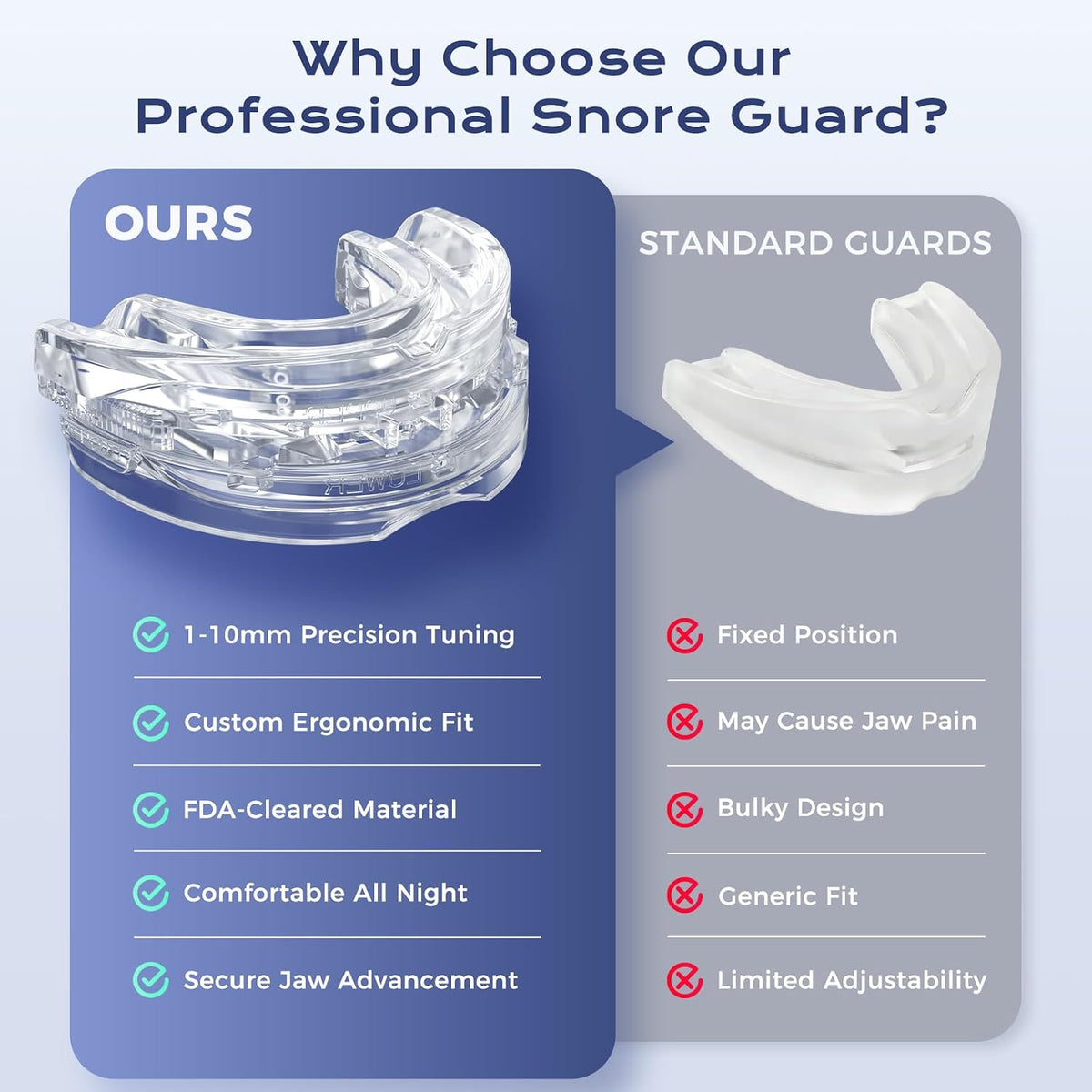
Most mouthguards hold your jaw in a fixed position and call it done. Hushwell is adjustable — because the distance your jaw needs to move to open the airway is different for every person. A device that can't be tuned to you is just a generic piece of plastic hoping for the best.

Hushwell adjustable anti-snoring mouthguard

The difference isn't the material. It's that you can actually set it to where your airway needs it.